

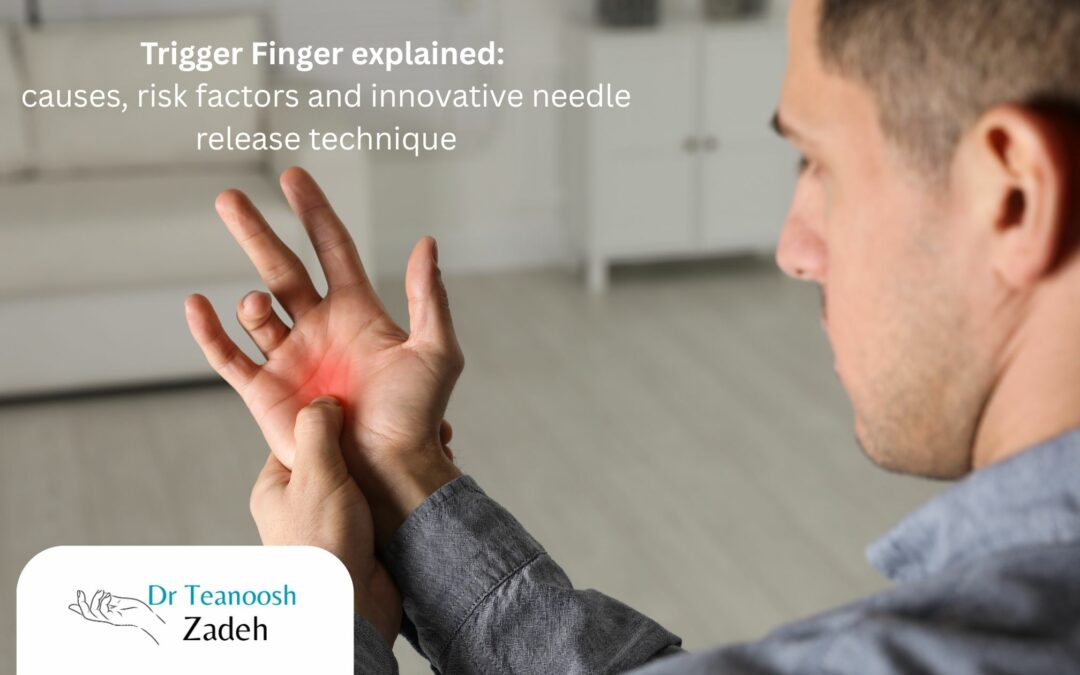
Trigger Finger Montreal patients often describe the same unsettling experience: a finger that clicks, catches, or becomes locked in a flexed position. What begins as mild discomfort at the base of the finger can progress to persistent stiffness, pain, and functional limitation that interferes with work, sports, and daily independence.
At his private hand surgery clinic in Montreal, Dr. Zadeh evaluates and treats stenosing tenosynovitis (trigger finger) with a focus on anatomical precision and long-term functional restoration. Whether you are experiencing morning finger stiffness and locking or a thumb locking condition that disrupts grip strength, early assessment allows for targeted Trigger Finger Treatment Montreal patients can trust.
“Dr. Teanoosh Zadeh” explains, “Trigger finger is not merely an inconvenience. It represents a mechanical mismatch between the flexor tendon and its sheath. Timely intervention prevents chronic inflammation and preserves fine motor coordination.”
What Is Trigger Finger (Stenosing Tenosynovitis)?
Trigger finger, medically termed stenosing tenosynovitis, is a finger tendon disorder affecting the flexor tendon as it glides through the A1 pulley or sheath at the level of the metacarpal head where the finger meets the palm of the hand.
Anatomy Involved
The condition centers on:
- The flexor digitorum superficialis and profundus tendons
- The A1 pulley at the volar aspect of the metacarpophalangeal joint
- The tendon sheath, responsible for smooth gliding mechanics
When flexor tendon inflammation and tendon sheath thickening occur, the tendon can no longer glide freely. The result is:
- Finger locking and clicking pain
- Finger stuck in bent position
- Pain at the base of the finger
- Reduced grip strength
In advanced cases, nodular enlargement of the tendon exacerbates mechanical obstruction, reinforcing the cycle of catching and release.
What Causes Trigger Finger?
Patients frequently ask: What causes trigger finger?
The pathophysiology involves repetitive microtrauma and inflammatory changes within the flexor tendon sheath. Contributing factors include:
- Repetitive hand strain from occupational tasks
- Diabetic trigger finger due to glycosylation-related tendon thickening
- Degenerative changes associated with aging
- Rheumatologic conditions
Inflammatory edema narrows the fibro-osseous canal, producing mechanical impingement. Over time, persistent compression can lead to progressive pain and functional compromise.
Who Is at Risk for Trigger Finger?
Trigger Finger cases are commonly seen in:
- Individuals performing repetitive gripping activities
- Patients with diabetes
- Women between 40–60 years
- Individuals with concomitant carpal tunnel syndrome
Non-Surgical Trigger Finger Treatment Options
Many patients seek Trigger Finger Treatment solutions before considering surgery.
Non-surgical treatment for trigger finger includes:
- Activity modification
- Splinting
- Anti-inflammatory measures
- Corticosteroid injection for trigger finger
Corticosteroid injection reduces tendon sheath inflammation and can provide substantial relief, particularly in early-stage disease. However, recurrence rates are high especially in diabetic patients or chronic cases.
If symptoms persist despite conservative measures, surgery is recommended.
Traditional Open Trigger Finger Release
A 2 cm incision is made in the palm at the base of the finger following local anesthesia with a numbing agent. Dissection is then carried down to the A1 pulley or sheath where it is released with a knife allowing the tendon to slide in and out easily. The incision is then closed with sutures and the hand is placed in a bandage for 10 days to 2 weeks. Patients may begin light activities after 2 weeks with full activity and use in 6 to 8 weeks. Patients may require a course of postoperative hand therapy to assist them with regaining their hand function.
Needle Release for Trigger Finger: A Minimally Invasive Alternative
Needle Release for Trigger Finger, also known as Percutaneous Trigger Finger Release, represents an innovative advancement in minimally invasive hand surgery.
What Is Percutaneous Trigger Finger Release?
This office-based trigger finger procedure involves releasing the constricting A1 pulley using a specialized needle under local anesthesia.
Key features include:
- Local anesthesia
- A 10 minute office procedure
- No incision
- No stitches
- No bandage
- Same-day consult & hand procedure
Using tactile anatomical guidance, the pulley is divided while preserving surrounding neurovascular structures. The flexor tendon regains unimpeded gliding immediately.
Is Needle Release Painful?
Most patients report minimal discomfort due to targeted local anesthesia. The procedure typically takes only minutes, making it a quick recovery hand procedure ideal for patients seeking efficiency and minimal downtime.
Trigger Finger Surgery Montreal has evolved significantly with this technique, offering a less invasive alternative to traditional open trigger finger release.
What to Expect After Percutaneous Trigger Finger Release
Recovery after trigger finger needle release is typically rapid.
Patients can expect:
- Immediate improvement in finger motion
- Mild soreness for a few days
- Almost immediate return to full hand function
Postoperative rehabilitation is almost never required with patients using their hands immediately after surgery.
In all cases, Trigger Finger Surgery Montreal planning is individualized to restore dexterity while protecting adjacent structures.
Complications if Untreated
Left unaddressed, chronic stenosing tenosynovitis may result in:
- Permanent flexion contracture
- Tendon degeneration
- Persistent pain
- Compensatory overuse injuries
Early evaluation by a Trigger Finger specialist in Montreal prevents long-term impairment.
Cost Considerations in Montreal
Costs vary depending on whether treatment involves corticosteroid injection, Needle Release for Trigger Finger, or open Trigger Finger Surgery Montreal. A private hand surgery Montreal consultation allows for personalized treatment planning and financial transparency.
FAQs About Trigger Finger Treatment Montreal
How is trigger finger treated in Montreal?
Treatment ranges from splinting and corticosteroid injection to Percutaneous Trigger Finger Release or open surgery.
Can trigger finger resolve without surgery?
Yes, very early cases may respond to cortisone injections though recurrence is high and persistent cases often require surgery.
How long does trigger finger surgery take?
Needle release is an office procedure and usually lasts a few minutes.
Open release is a 15 to 30 minute procedure.
Both are performed under local anesthesia.
When should I see a trigger finger doctor near me?
Seek evaluation if you experience finger locking, pain at the base of the finger, or reduced grip strength lasting more than several weeks.
Restoring Motion and Independence
Loss of hand function affects professional performance, athletic participation, and personal independence. Whether you require conservative management or advanced Trigger Finger Surgery Montreal intervention, timely care prevents chronic disability.
If you are experiencing finger clicking, locking, pain, weakness, or reduced hand function, schedule a consultation with Dr. Zadeh at his Hand Clinic Montreal for comprehensive evaluation and individualized Trigger Finger Treatment Montreal planning.