

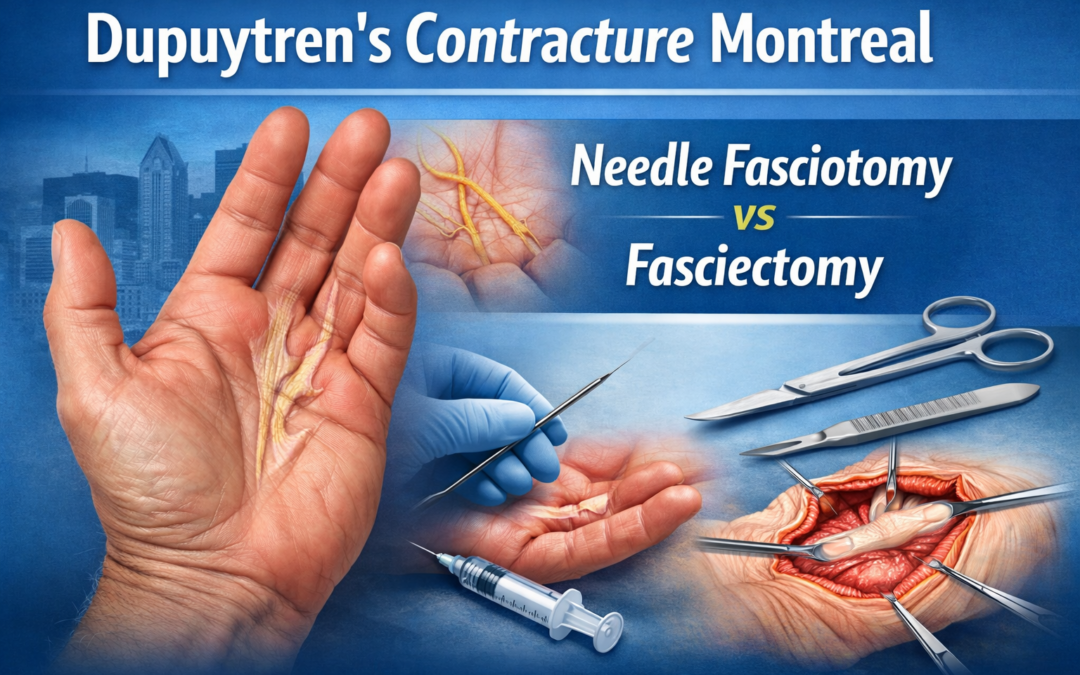
Dupuytren’s Contracture Montreal: Understanding Fascia and Choosing Between Needle Fasciotomy and Fasciectomy
Dupuytren’s Contracture Montreal patients often first notice a subtle thickening in the palm — a firm nodule, a cord beneath the skin, or fingers bending toward the palm. What begins as a painless lump can gradually evolve into a digital flexion contracture that interferes with grip, dexterity, and independence.
At his private hand surgery clinic in Montreal, Dr. Zadeh evaluates each patient personally, focusing on restoring functional alignment, relieving contracture, and preserving long-term hand performance. Dupuytren’s Contracture Treatment requires anatomical precision, careful staging, and individualized surgical judgment.
What Is Dupuytren’s Contracture? Understanding Palmar Fascia Pathology
Dupuytren’s Contracture refers to a fibroproliferative disorder affecting the palmar fascia — the dense connective tissue layer beneath the skin of the palm. This fascia stabilizes the hand during power grip and fine motor activity.
In Dupuytren’s disease:
- Palmar fascia thickening develops
- Palmar nodules and cords form
- Progressive shortening of fascial bands pulls fingers into flexion
- A fixed digital contracture emerges
The ring and small fingers are most commonly affected. As cords mature, patients may report:
- Cannot lay hand flat on table
- Thick cords in palm of hand
- Hand contracture progression
- Grip restriction and functional hand limitation
“Early intervention is about preserving function before stiffness becomes structurally fixed,” explains Dr. Teanoosh Zadeh. “The longer a joint remains contracted, the more secondary capsular and tendon adaptations develop.”
Why Does Dupuytren’s Disease Develop? Risk Factors Explained
Although the exact etiology remains multifactorial, Dupuytren’s Contracture is strongly associated with:
- Genetic predisposition (Dupuytren’s is often hereditary)
- Northern European ancestry
- Male sex, typically over 40
- Diabetes and metabolic comorbidities
- Smoking and vascular compromise
The pathology involves abnormal fibroblast proliferation and collagen deposition within the palmar fascia, leading to progressive contracture without primary tendon involvement.
Signs and Symptoms of Dupuytren’s Contracture
Patients seeking Dupuytren’s Contracture Treatment often describe:
- Lump in palm
- Progressive fingers bending toward palm
- Difficulty shaking hands or putting on gloves
- Reduced grip strength and hand endurance
- Inability to place the hand flat on a table (tabletop test)
Unlike trigger finger, flexor tendon rupture, or inflammatory tenosynovitis, Dupuytren’s does not originate from tendon inflammation. Over time, joint stiffness can become increasingly resistant to passive correction without procedural treatment.
Early Non-Surgical Options (Steroid Injections & Observation)
For mild cases without significant contracture, Dupuytren’s Contracture Treatment may include:
- Observation and serial measurements to monitor progression
- Selective steroid injections for painful nodules
- Education on function-preserving habits and early warning signs
However, once metacarpophalangeal (MCP) or proximal interphalangeal (PIP) contracture reaches a functional threshold, procedural intervention becomes more appropriate.
Needle Fasciotomy Montreal: A Minimally Invasive Option
Needle Fasciotomy Montreal (also called percutaneous needle fasciotomy) is a minimally invasive Dupuytren’s procedure performed under local anesthesia. The goal is to divide the pathologic fascial cord through a small skin entry point, allowing immediate finger extension.
Technique Overview
- A fine needle is introduced through the skin over the cord
- The cord is mechanically weakened and divided in a controlled manner
- The finger is gently extended to release residual tension
Benefits of Needle Fasciotomy Montreal
- Outpatient hand surgery with no incisions
- No visible scars
- Rapid functional return for many patients
- Short procedure time (often 10-20 minutes)
“Needle Fasciotomy can be highly effective in carefully selected patients,” says Dr. Teanoosh Zadeh. “The objective is a controlled release of the cord while protecting the digital nerves, arteries, and tendons, structures that can be intimately tethered to diseased fascia.”
Recovery After Needle Fasciotomy
There is little to no downtime after needle fasciotomy, with the majority of patients using their hands immediately.
Fasciectomy Montreal: When Is Open Surgery Necessary?
Fasciectomy Montreal (an open fasciectomy procedure) is a traditional approach to Dupuytren’s Surgery. During Dupuytren’s Surgery, the diseased fascia is excised, improving finger extension and hand alignment.
Surgical Overview
- Planned incisions in the palm and affected digit
- Identification and protection of digital nerves and arteries
- Excision of pathologic fascial bands
- Selective neurolysis when nerve tethering is present
- Post-operative splinting and structured rehabilitation over many months
Comparing Needle Fasciotomy vs Fasciectomy
Choosing between Needle Fasciotomy and Fasciectomy depends on the surgical skill set and experience of the surgeon performing the needle technique. Dr. Zadeh has been performing the Needle Fasciotomy technique for over 20 years. For many patients, the most important questions are “How soon can I use my hand” and “How well will my hand work afterward?”.
Needle Fasciotomy
- Minimally invasive, rapid recovery
- No scars
Fasciectomy
- More comprehensive removal of diseased fascia
- May offer improved durability for advanced disease patterns
- Longer recovery over months and more intensive hand rehabilitation
Recovery Timeline and Post-Operative Care
Post-operative care is not an afterthought, it is part of the surgical plan. Functional restoration requires protecting repaired tissues while restoring glide, extension, and strength through staged rehabilitation.
After Needle Fasciotomy
- Soft dressing for 1-3 days
- Early mobilization and tendon-gliding exercises
- Return to work varies by occupation, often within a few days
After Fasciectomy
- Wound care and swelling control
- Hand therapy to restore range of motion and dexterity
- Return to full activities can take 12-16 weeks depending on severity
Risks, Complications and Recurrence
All Dupuytren’s Contracture Treatment options carry potential risks. The Fasciectomy (open technique) has a higher complication rate as compared to The Fasciotomy (needle technique). Dr. Zadeh reviews these in detail, balancing procedural benefit with long-term hand function and safety.
- Scar formation risk and sensitivity
- Stiffness, particularly at the PIP joint
- Digital nerve irritation or neurapraxia
- Delayed wound healing (more relevant with open procedures)
- Recurrence rate, influenced by genetics and disease biology
FAQs About Dupuytren’s Contracture Treatment in Montreal
What are Dupuytren’s contracture treatment options?
Options include observation for early disease, selective steroid injections for painful nodules, Needle Fasciotomy for suitable cords, and Fasciectomy.
What is the best treatment for Dupuytren’s contracture?
The treatment with the lowest morbidity is the needle fasciotomy technique.
How long does Dupuytren’s surgery take?
Needle fasciotomy often takes 10-20 minutes. Fasciectomy may take 60–120 minutes depending on the number of cords and digit involvement.
What is recovery after needle fasciotomy like?
Most patients resume regular activities within days. Hand therapy is unlikely.
When is surgery needed for Dupuytren’s contracture?
Surgery is considered when contracture affects function, the hand cannot be placed flat. A diagnostic evaluation clarifies staging and the most appropriate procedure.
What is the recurrence rate after Dupuytren’s surgery?
Recurrence varies by technique and individual biology. Minimally invasive approaches and open fasciectomy seem to provide similar recurrence rates.
Cost Considerations for Dupuytren’s Contracture Treatment Montreal
The cost of Dupuytren’s surgery in Montreal depends on procedure type (Needle Fasciotomy vs Fasciectomy), disease complexity, facility setting, and required postoperative rehabilitation. A consultation allows Dr. Zadeh to provide a clear plan and expectation framework.
Schedule a Consultation With a Dupuytren’s Specialist in Montreal Patients Trust
If you are noticing fingers bending toward the palm, thick cords in the palm of your hand, reduced grip strength, or progressive loss of dexterity, request a diagnostic evaluation at Dr. Zadeh’s hand surgery clinic in Montreal. Dupuytren’s Contracture Treatment is most effective when it is personalized, aligned to your anatomy, your function, and your goals.
To explore minimally invasive options such as Needle Fasciotomy or determine whether Fasciectomy is the most appropriate path, schedule a consultation with Dr. Zadeh today.