

What Is Needle Release for Trigger Finger? A Surgeon Explains the Technique
Trigger finger can begin as a subtle inconvenience, a slight catching sensation when bending your finger, but it often progresses into painful locking, stiffness, and loss of fluid motion. For patients in North America seeking a precise, minimally invasive solution, Needle Release for Trigger Finger has emerged as an effective alternative to traditional surgery. However, this technique is only done by very few surgeons with the appropriate skills set.
At his specialized hand surgery clinic in Montreal, Dr. Zadeh performs Percutaneous “needle” trigger finger release surgery, for over 25 years.
What Is Trigger Finger? Stenosing Tenosynovitis Explained
Trigger finger, medically known as stenosing tenosynovitis, is a condition affecting the flexor tendon system. The flexor tendons glide within a protective sheath, stabilized by pulley structures. The A1 pulley, located at the base of the finger, is the most common site of pathology.
When inflammation or thickening occurs, the tendon can no longer glide smoothly. This results in:
- Finger locking and clicking
- Pain at the base of the finger or thumb
- Morning stiffness
- Reduced grip strength
- Mechanical catching during flexion and extension
“Trigger finger represents a biomechanical imbalance between the tendon and its sheath,” explains Dr. Teanoosh Zadeh. “If untreated, this mismatch can progress to persistent functional limitation.”
What Is Needle Release for Trigger Finger?
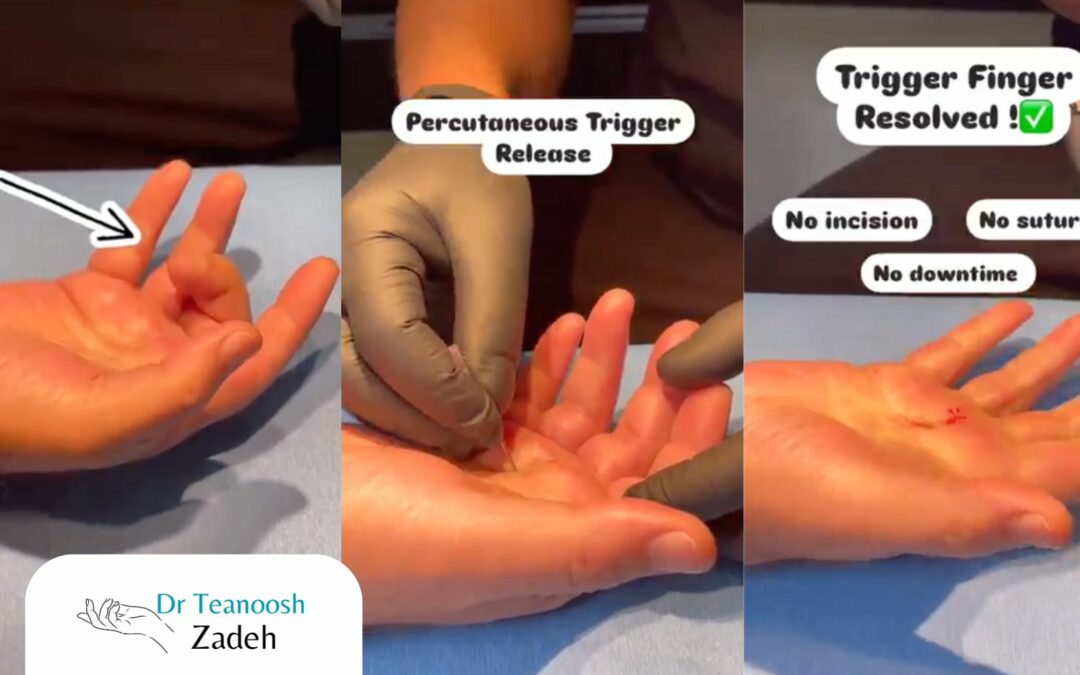
Needle Release for Trigger Finger is a minimally invasive, office-based procedure designed to relieve tendon entrapment without an open incision.
Also known as Percutaneous Trigger Finger Release, this technique involves using a fine needle to divide the constricting A1 pulley, restoring normal tendon motion.
Unlike Open Trigger Finger Surgery, this approach:
- Requires no stitches
- Requires no incision
- Allows immediate finger movement
- Minimizes tissue disruption
For many patients seeking Trigger Finger Treatment, this technique offers a streamlined path to quick recovery with excellent functional outcomes.
How the Needle Release Procedure Works
Local Anesthesia
The procedure begins with precise local anesthesia to numb the affected area while preserving patient awareness and feedback.
Needle Insertion
A fine needle is introduced through the skin at the level of the A1 pulley. The approach is highly controlled and guided by anatomical landmarks.
A1 Pulley Release
Using controlled micro-movements, the needle is used to divide the constricted pulley. This releases the tendon and eliminates mechanical obstruction.
Immediate Motion Testing
The patient is asked to actively move the finger during the procedure to confirm smooth tendon gliding and resolution of locking.
“Precision is critical,” notes Dr. Teanoosh Zadeh. “The goal is to release the pulley while preserving surrounding neurovascular structures and maintaining tendon integrity.”
Benefits of Needle Release Compared to Open Surgery
For all patients, Trigger Finger Needle Release offers several advantages over open surgery:
- Minimally invasive technique with no incision
- Minimal postoperative discomfort
- Immediate restoration of finger mobility
- Almost immediate return to daily activities (v.s 3-6 weeks with the open technique)
- No scarring
This makes it an attractive option for individuals seeking minimally invasive hand surgery with no downtime.
Who Is a Candidate for Needle Release?
All patients with Trigger Finger are potential candidates for curative Needle Trigger Finger Release Surgery.
What to Expect After the Procedure
After the procedure:
- A bandaid is applied
- Patients can use their hand almost immediately
- Light activities are encouraged the same day
Recovery After Trigger Finger Needle Release
Recovery following Needle Release for Trigger Finger is typically rapid and predictable.
Patients experience:
- Immediate reduction in locking
- Gradual resolution of soreness (3-4 days)
- Restoration of grip strength within days to weeks
Contrary to Open Surgery, the vast majority of patients do not require postoperative rehabilitation.
“When we restore tendon gliding early, we preserve long-term hand function and prevent secondary stiffness,” says Dr. Teanoosh Zadeh.
Are There Any Risks or Complications?
Contrary to Open surgery, the potential risks of Percutaneous Trigger Finger Release are significantly less and include:
- Temporary soreness or swelling
- Incomplete release requiring further treatment
- Rare nerve or vascular irritation
- Recurrence of symptoms
Surgical expertise significantly reduces these risks.
Needle Release vs Open Trigger Finger Surgery
Patients often compare needle release vs Open surgery options when considering treatment.
Needle Release
- Minimally invasive
- No incision or sutures
- Faster recovery (1-3 days)
Open Surgery
- Direct visualization of structures
- Suitable for complex or recurrent cases
- Much longer recovery (3-6 weeks)
- Incision required
- Bandage and unable to wet hand for 10 days- 2 weeks
Steroid Injection vs Needle Release
Corticosteroid injections may reduce inflammation temporarily but do not address mechanical constriction. Needle release provides a definitive solution by resolving tendon entrapment.
Consultation With Dr. Zadeh
Choosing the right treatment for trigger finger requires a precise anatomical evaluation and individualized planning.
At a leading hand surgery clinic in Montreal, Dr. Zadeh provides:
- Comprehensive diagnostic assessment
- Personalized treatment recommendations
- Expertise in minimally invasive and open techniques
- Continuity of care from consultation through recovery
Patients searching for a trigger finger specialist Montreal or minimally invasive needle release hand surgeon near me benefit from a tailored approach focused on functional restoration.
If you are experiencing finger locking, pain, or reduced hand function, scheduling a consultation allows for early intervention and optimal outcomes.
FAQ
What is needle release for trigger finger?
It is a minimally invasive procedure that uses a needle to release the A1 pulley and restore normal tendon movement without open surgery.
Is needle release better than open surgery?
Needle release offers much faster recovery and less tissue disruption.
How long does it take to recover from needle release?
Most patients resume normal hand use within days, with continued improvement over several weeks.
Is the procedure painful?
Local anesthesia minimizes discomfort. Patients typically experience only mild soreness afterward.
Can trigger finger come back after needle release?
Recurrence is possible but uncommon when the pulley is adequately released. However, there can be a recurrence of inflammation.